There is a meeting happening in your company right now about AI — sign of the times, can't be wrong to go with the flow. It has a budget, a slide deck, a vendor shortlist, perhaps a steering committee with a name that ends in "of Excellence." And there is another conversation — the one that quietly decides whether the company still has a reason to exist in five years — and it is on no one's agenda.
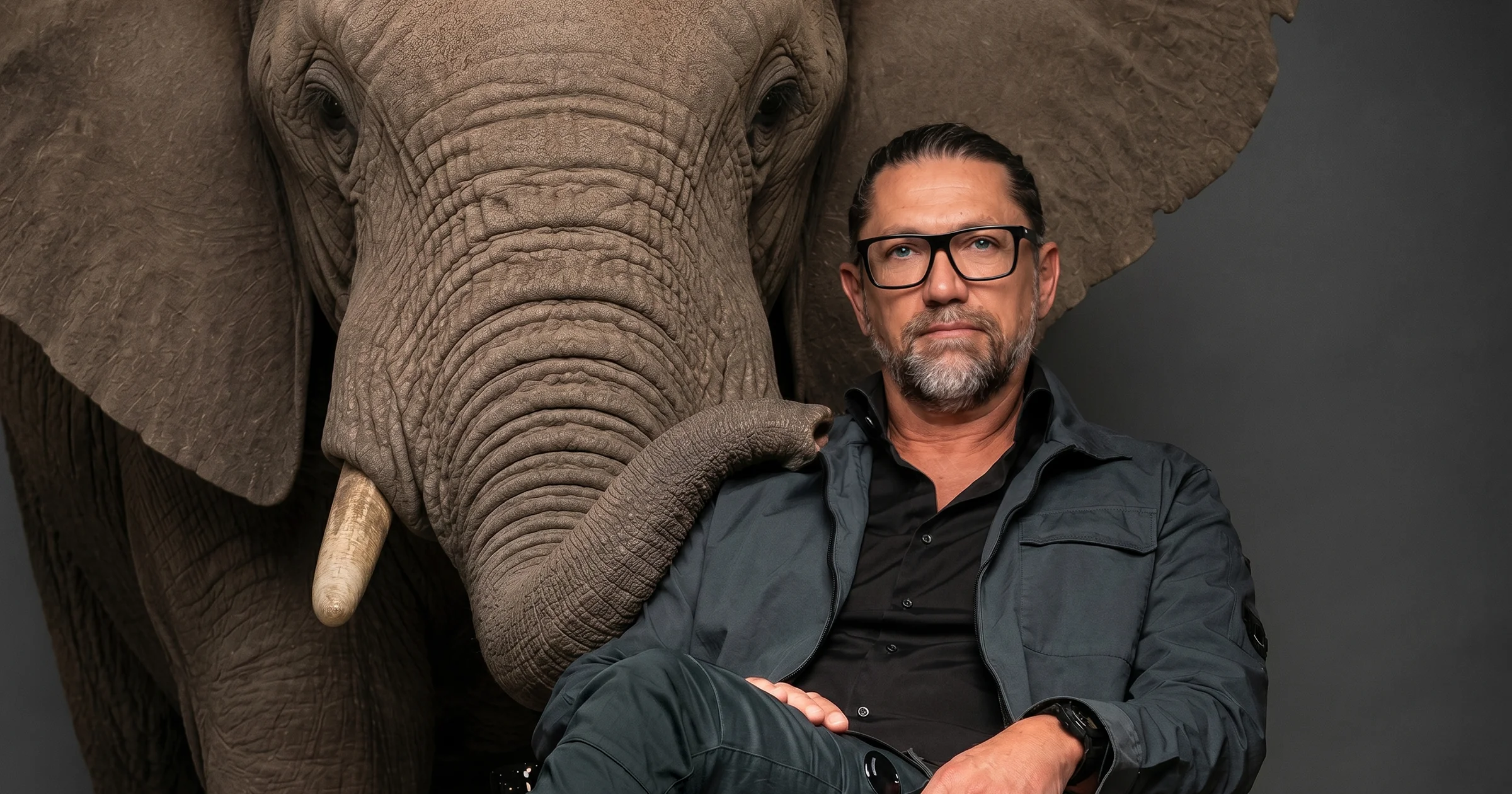
The Elephant in the Room: Talking About AI May Actually Be Your Reason To Conveniently Look Away.
Everyone is having the AI conversation. Only a few dare engage in the challenging one behind it.
01 · The dodge
The AI convo actually masks out relevance.
We all fall so easily for the drama spiral: will AI take our jobs? Will it finally make us efficient? Should we govern it or unleash it, fear it or deploy it? These questions fill every conference, every feed, every offsite with a whiteboard and a catered lunch. They are not foolish questions. They are real.
But notice what they share. Every one of them keeps the subject of the sentence pointed outward — at the tool, the trend, the arriving force out there. Not one of them turns the sentence around to point at you: at what your company actually does, and at why a customer would still choose it next year over whatever AI is about to make possible for someone else. The conversation is engineered, almost perfectly, to be about everything except the one thing it keeps gesturing toward.
That is not an accident. It is a relief. A conversation about the technology is infinite, fascinating, and safe. A conversation about your own continued relevance is short, uncomfortable, and has your name on it. Given the choice, a room will pick the first one every single time — and congratulate itself on being forward-looking while it does.
An AI initiative is the most legitimizing way a company has ever found to look busy while looking away.
02 · The question underneath
Did your customers ever buy your product or service — or just the promise of a solution to their needs and problems?
Here is the lens that cuts through all of it, and it is not mine. Clayton Christensen spent a career on a deceptively simple idea: people don't buy products, they hire them to make progress — to get a job done in their lives. Nobody wants a quarter-inch drill; they want a quarter-inch hole, and they would happily fire the drill the moment something gets them the hole faster, cheaper, or with less mess. Your customers were never loyal to you. They were only ever after the solution and their benefit — or at least the promise of it. Always have been, always will be.
Run the AI question through that lens and it changes shape entirely. The threat was never that a competitor offers a better model than yours — those are bought by everyone, all the time, at various price points. The threat is that the job your customer hires you for becomes something AI can do directly, or makes someone else able to do so much better that the comparison stops being close.
This is not a new way to die. Theodore Levitt named it in 1960: the railroads did not decline because demand for transportation fell — it exploded. They declined because they had decided they were in the railroad business rather than the transportation business, and so they watched their customer walk to the car and the aeroplane without ever feeling addressed. The mistake is sixty-five years old. AI has simply deleted the decades of warning that used to come with it.
And the part nobody in the AI meeting wants to say out loud: owning the technology buys you nothing durable. Nicholas Carr made that argument in 2003 — once a technology is cheap and available to everyone, having it stops being an advantage; the edge migrates permanently to what you build on top. Rita McGrath took the next step: advantage itself is now transient, and the only real edge left is the discipline of asking, continuously, whether the thing you are good at is still the thing the market rewards. AI does not change that logic. It just shortens the fuse on it.
Your customers were never loyal to you. They were loyal to the job you got done. The only question that has ever mattered is whether you're still the best way to get it.
03 · Naming the animal
The elephant is not AI — but the question with no vendor: is what we do still worth choosing?
So let me say the thing the meeting is built to avoid, plainly, because somebody in the room has to.
The elephant is not AI. It never was. AI is the most-discussed subject in the building — and nothing that commands this much airtime is being avoided. The elephant is the question AI keeps pointing at and the organisation keeps stepping around: are we still relevant enough to be hired for the job — to whom, and for how much longer?
That is the whole animal, in one sentence. It stood in the room long before the first Copilot licence. AI did not put it there. AI merely turned the lights on and made it harder to keep not-seeing it.
And here is why that question is so reliably dodged: it has no vendor. There is nobody to buy it from, no demo to schedule, no maturity model to slot yourself into, no partner to share the blame with if it goes wrong. "Is our business still the one customers want to hire?" has no procurement process. So it loses — every single time — to a question that does. An AI programme has a budget line, an owner, a deadline, a flattering story, the cover of everyone-else-is-doing-it, and the visible appearance of motion. The relevance question has none of those. Five boxes ticked versus zero. The meeting that should be about whether customers still need you becomes, predictably, a meeting about the tool.
Which is exactly where I come in — and I should be straight about why it's me saying this and not the firm with the fancy high-gloss deck. Most advisors are commercially built to discuss the tool. An AI engagement has a scope, a deliverable, a renewable contract; "your business model has a relevance problem" has none of those, and naming it can end the engagement instead of extending it. I've made the opposite bet. I don't sell the wand and I don't sell the methodology — I'm the one whose only job is to point at the animal everyone else is professionally incentivised to walk around. (I've written about which kind of advisor is structurally able to do that — the Jester, the one with permission to tell the king the truth precisely because he isn't selling the king anything — in The Other Type of Consultant.) Pointing at the elephant is not a side effect of how I work. It is the work.
04 · Your move
Park the AI project for one minute. See what's still standing in the room.
You do not need a framework to find your own elephant. You need one honest question, asked when nobody is selling you anything:
If the entire AI initiative were quietly cancelled tomorrow — no tooling, no roadmap, no programme — what unresolved question would still be sitting in the room? Whatever surfaces is your elephant. And the AI project is very often the most expensive, most respectable way an organisation has yet found not to answer it.
Two more, for the next time the conversation drifts comfortably back to the tool. What conversation is this AI work letting us avoid? — and if nothing comes to mind, sit with it longer, because the absence of an answer is usually the answer. And the blunt one for the steering meeting: if a customer could get the job done without us next year, would they? The honesty of that answer is the whole game.
None of this is an argument against AI. On the contrary, by all means: adopt it — seriously, and soon. It is an argument against using it as anaesthetic: the well-funded, respectable activity that lets a leadership team feel decisive while postponing the one decision that actually matters. Buy the tool. Just don't let buying it count as having answered the question it is standing in front of.
Because once you are willing to look at the elephant, the next question is what shows you — precisely, and without flattery — what is actually there. That turns out to be a different instrument entirely. And it is where this conversation goes next.

Recommended reading
Six sources for finding the peanut.
Not on AI — on relevance, customer choice, and why advantage decays. The reading that helps you interrogate the elephant directly, rather than the technology standing in front of it. Pick one and read past the article you're in.
⊛
Competing Against Luck
Book · Jobs-to-be-done
Competing Against Luck
Jobs-to-be-done in full. Why customers hire and fire products, and how to see your business through the only lens that survives a technology shift: the progress the customer is trying to make.
hbs.edu◈
Marketing Myopia
HBR · Strategy
Marketing Myopia
The railroad essay. The original, and still the sharpest, account of how a thriving business defines itself to death by its product instead of the job it does. The elephant, sixty-five years early.
Read on HBR◆
IT Doesn't Matter
HBR · Technology
IT Doesn't Matter
Why owning a technology stops being an advantage the moment everyone can. The argument that explains why "we have AI" will never be a strategy — and what has to replace it.
Read on HBR◐
The End of Competitive Advantage
Book · Strategy
The End of Competitive Advantage
Advantage is now transient. The discipline of continuously re-checking whether what you're good at is still what the market rewards — the operating habit the relevance question demands.
ritamcgrath.com◑
Crossing the Chasm
Book · Market adoption
Crossing the Chasm
How adoption really moves through a market — and why being early to a technology means nothing if you misread who is actually ready to choose you, and why. The customer side of the AI rush.
geoffreyamoore.com◐
The Other Type of Consultant
POV · Companion piece
The Other Type of Consultant
The companion piece. Who is structurally able to name the elephant — and why most advisors are commercially built to discuss the tool instead. The methodology behind this diagnosis.
Read POV #1Frequently asked
Questions readers have asked.
01. So what exactly is the elephant, in one sentence? +
The elephant is not the technology — it's the question the technology keeps pointing at and the organisation keeps walking around: is what we do still relevant, to whom, and why would they keep choosing us? AI didn't create that question. It just made it loud enough that ignoring it now takes visible effort.
02. Isn't "relevance" too soft to put in front of a board? +
Make it concrete and it stops being soft. Christensen's version is brutally specific: customers hire you to get a job done, and they'll fire you the moment something does it better. So the board question isn't "are we relevant" — it's "what job do customers actually hire us for, and is AI quietly becoming a better way to get it done than we are?" That has numbers attached, and a clock.
03. Why is AI specifically the thing companies hide behind? +
Because it ticks every box a hard question can't: a budget line, a vendor, a deadline, a flattering story, social cover, and the visible appearance of motion. The relevance question ticks none of them — no supplier, no due date, no comfortable narrative. So the meeting that should be about whether customers still need you becomes, reliably, a meeting about the tool.
04. If AI hasn't delivered returns yet, doesn't that mean we can wait? +
That's the comfortable misreading. Thin returns don't mean nothing is changing — they mean most firms bolted a powerful tool onto a business they never re-examined. Carr's logic still bites: owning the technology was never the advantage, and it commoditises fast. What doesn't commoditise is a defensible answer to why a customer chooses you. Waiting doesn't build that answer; it just shortens the time you have to find it.
05. Are you telling companies not to invest in AI? +
The opposite. Adopt it seriously, and soon. The argument is against using AI as anaesthetic — the respectable, well-funded activity that lets a leadership team feel decisive while postponing the decision that actually matters. Buy the tool. Just don't let buying it count as having answered the question it's standing in front of.
06. How do I find my own elephant without hiring anyone? +
One question: if the entire AI initiative were cancelled tomorrow, what unresolved question would still be sitting in the room? Whatever surfaces is usually it. A blunter version for the next steering meeting: if a customer could get the job done without us next year, would they? If that one's uncomfortable to answer out loud, you've found the elephant.
07. Why are you the one pointing this out, and not my current advisors? +
Because most advisors are commercially structured to discuss the tool. An AI engagement has a scope, a deliverable, and a renewable contract; "your business model has a relevance problem" has none of those, and naming it can end the engagement rather than extend it. I've written about which kind of advisor is structurally able to name the elephant in The Other Type of Consultant — the Jester being the one with permission to tell the king the truth precisely because he isn't selling the king a methodology.
The conversation worth having
Want to address the elephant together?
Sixty minutes. No agenda required. By the end, you'll know whether the question you walked in with is the one worth answering — or whether the AI conversation has been standing in front of a bigger one all along.