What the Digital Factory could have taught us — but how we are prone to make the same mistakes again.
Robert DanielApril 20264 min read
I have had a version of this conversation more than once in the past year:
"We rolled out Copilot to a hundred people six months ago. Adoption is at seventy-eight percent. Our workflows haven't changed. What did we miss?"
The owners asking are not naïve. They have technology budgets that work. Their teams are using the tools. The dashboards show green. And yet the business they were promised — the one where AI redesigns how value gets created — has not arrived.
What did they miss?
Probably just one simple fact — that buying technology and being transformed by it are not the same thing. They never were. We learned this in the digital wave. We are about to learn it again, faster, harder, and at exponentially higher cost.
01 · The Digital Factory mirror
The digital wave — an opportunity mostly missed.
What I think of as the Digital Factory era — roughly 2010 to 2020 — was the largest enterprise technology adoption cycle since the introduction of personal computing. Companies bought CMS platforms, marketing automation, CRM systems, the lot. Most of those implementations were technically successful. Most of the transformations were not.
Nicholas Carr saw this two decades earlier when he asked, in a now-famous Harvard Business Review piece, whether IT mattered at all. His answer was unwelcome but clarifying: the strategic value was never in having the technology — it was in what you redesigned around it.
I watched this play out at Allianz. The data was already there. The platforms worked. What was missing was the reframing of digital from a marketing cost line into a P&L position. Sixteen new revenue streams in twelve months came out of that reframing — not out of any new tool.
The technology was the excuse. The strategy was the work.
02 · Same trap, new mask
Bought is not adopted. Adopted is not transformed.
The economist Robert Solow once observed that you could see the computer age everywhere except in the productivity statistics. Erik Brynjolfsson traced this paradox for thirty years and found a consistent answer: the productivity gains from a new general-purpose technology only show up after the organizations using it have redesigned themselves around what it makes possible. There is always a lag. The lag is usually a decade.
Carlota Perez calls this the difference between installation and deployment. We are clearly in the installation phase of AI — chaotic, speculative, full of investment without coherence. The deployment phase, where the real economic value gets unlocked, comes later, and only for the organizations that did the deeper work in the meantime.
Bought, adopted, and transformed are three different states. Most companies confuse the second for the third — and stop there.
03 · Same licence. Different question.
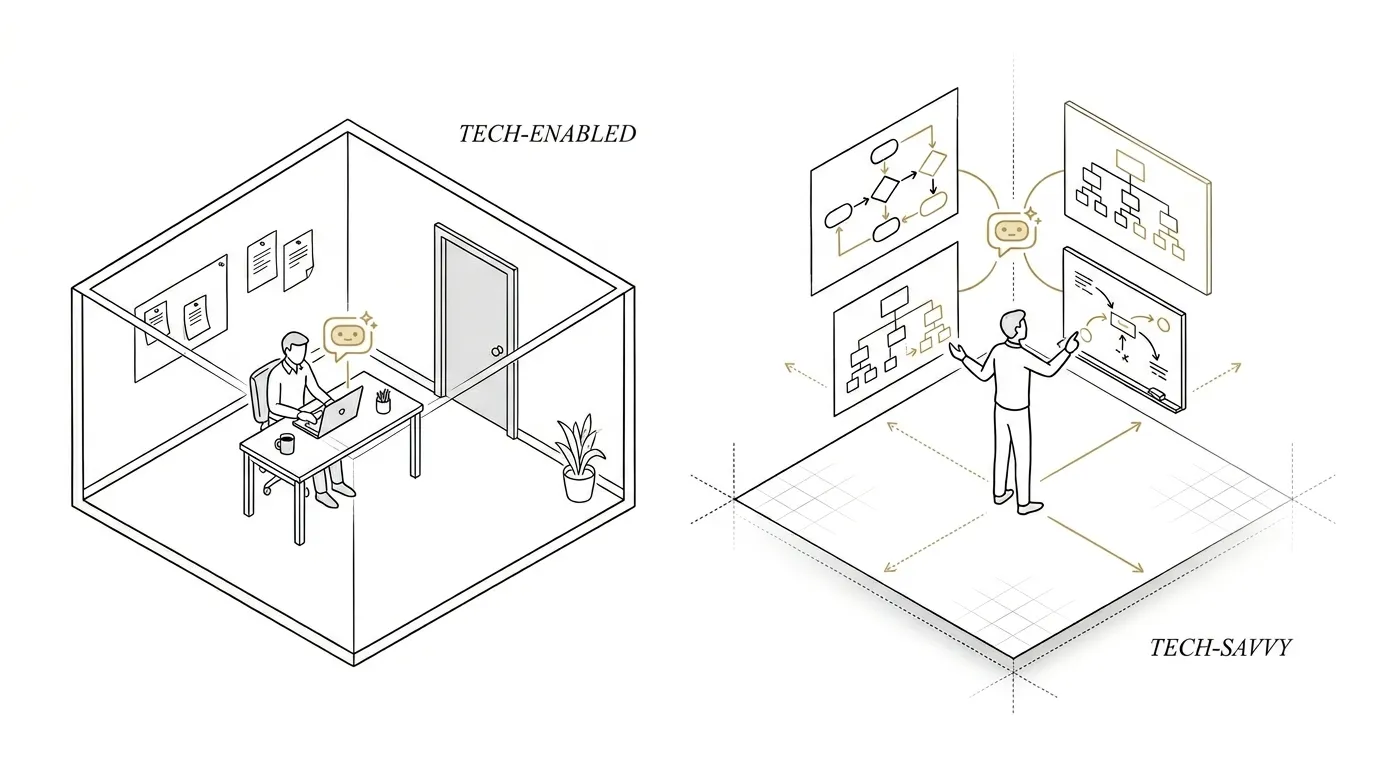
Tech-enabled ≠tech-savvy.
Ethan Mollick, who studies this more honestly than most, keeps repeating the same point: we are still using the worst AI we will ever have, and we still haven't figured out the workflows. The tools are running ahead of the thinking.
Two companies are issued the same Copilot licence. Same training. Same rollout. The first uses it to write emails faster. Reports come together in less time. Meeting notes get cleaner. By every adoption metric, the program has succeeded. Yet the business itself remains as before — just slightly more efficient at doing what it already did.
The second company asks a different question: which decisions are we now making five times a day that we used to make once a week, and are the decision rights still allocated correctly? That question pulls on operating model. It pulls on governance. It pulls on the way work is structured.
Both companies are tech-enabled. But only the second is tech-savvy.
That is where transformation lives — or doesn't.
04 · A live proof, in slow motion
What it looks like when it actually happens.
DarkTools came to me nine months ago with a website problem. Their content management system was fragile, updates not working, the database collapsing under a complex product catalogue. The brief was a redesign.
Several weeks in, we were no longer talking about a website. We were talking about a Product Information Management architecture — a single source of truth feeding not only the website, but all the channels and platforms in the tech stack, including the operations. We were talking about how AI would govern data quality at the input layer, not generate copy at the output layer. We were talking about who would be allowed to instruct an agent to update a product spec, and who would have to approve it — the kind of governance question I will return to in a separate piece.
That conversation is not a website project. It is an operating model redesign with AI as a structural assumption, not a feature. The website still gets built. But it gets built as one individual skin of an entirely new business model, not as the system itself.
That is what tech-savvy looks like in practice. It is slower. It is harder. It compounds.
05 · The two questions. Not one.
Stopping at the first question will probably set you up for epic failure.
Every owner facing an AI decision is implicitly answering two questions. Most only notice the first.
What are we buying?
What are we redesigning around what we have bought?
The first one is easy. There are vendors, demos, decks, comparison matrices. The procurement process has a budget line and a timeline. Everyone knows what to do.
The second question is harder. Because there is no vendor. No demo. No matrix. The answer involves the operating model, the decision rights, the way the business has organized itself for the past decade or two.
Most companies stop after the first question. But asking the second one, and finding answers, truly sets the others up for success.
You can be tech-enabled and still go nowhere. The companies that ask the second question end up ahead of the wave — not under it.
Robert Daniel
Strategy Advisor · Hamburg
Investigator of the second question · Tech-savvy since birth
From the historical pattern of digital transformation to the current AI moment — economic framing, adoption gaps, infrastructure precedents, and the philosophical stakes. Pick one and read past the article you're standing in.
⚙
The Second Machine Age
Brynjolfsson · McAfee
Book · Economics
The Second Machine Age
Erik Brynjolfsson & Andrew McAfee · 2014
Canonical economic framing of the digital wave. Why this technology shift was structurally different from those that came before — and what that pattern tells us about AI now.
The technology adoption lifecycle. Why most companies fail in the gap between early adopters and the pragmatic majority — exactly where most AI initiatives are stalling right now.
The single most important precedent for the AI moment. When infrastructure-tech becomes commoditized, competitive advantage moves to how it's used — not what it is.
Christensen, Matzler & Friedrich von den Eichen · DE ed.
Why incumbent companies, doing everything "right," still miss disruptive transitions. The pattern at the heart of this article — adapted for the DACH context.
Henry Kissinger, Eric Schmidt & Daniel Huttenlocher · 2021
A heavyweight trio — statesman, technologist, computer scientist — making the case that AI is a civilizational shift, not a productivity tool. Lifts the conversation above the immediate transformation question.
Specific to this article. General questions about working with Robert live on the About page.
01Are you arguing companies shouldn't adopt AI?+
No — I'm arguing they should adopt it like it matters, not like it's a checkbox. The companies that got the digital wave right didn't avoid digital. They built around what digital actually changes. The companies that got it wrong bought tools and called the project complete. The same fork is in front of every company right now, with AI as the substrate.
02What's the actual Digital Factory parallel — wasn't that a different era?+
The era was different. The pattern wasn't. In the early 2000s, big companies set up "Digital Factories" — separate units tasked with building digital products in parallel to the main business. Most of them produced lots of activity and very little compounding value. Why? Because the rest of the business kept running on the pre-digital operating model. The Factory did digital. The company didn't become digital. The same gap is forming now between "AI initiatives" and how the actual business operates.
03How do I know if my AI initiative is "tech-enabled" or "tech-savvy"?+
One question that usually surfaces it: is the value of this initiative still legible if you removed the AI from the description? If "we built an AI-powered customer service tool" makes sense, you're tech-enabled. If "we redesigned how customer relationships work, and AI is one of the layers that makes the new model possible" makes sense, you're moving toward tech-savvy. The difference is whether AI is the headline or the enabler.
04Doesn't moving slowly mean falling behind in a fast-moving market?+
Moving slowly is not the same as moving carefully. The companies that fell behind in the digital era weren't the ones who paused to think — they were the ones who substituted activity for thought, built fast, and scaled the wrong thing efficiently. Speed without diagnosis is just expensive motion. Speed with diagnosis is where leverage actually compounds.
05What does "AI as infrastructure" mean concretely?+
It means AI shows up in the business not as a product feature ("our app uses AI!") but as a layer in how the company decides, operates, and serves. Like electricity in 1920 — invisible, ambient, structurally rewriting how production was organized, but rarely the product on the shelf. You don't sell electricity. You sell what electricity makes newly possible. That's the AI question for most companies right now.
06Is governance just bureaucracy that slows AI down?+
Bad governance is bureaucracy. Good governance is how you make AI deployable in the first place. The question isn't whether to govern AI — it's whether your governance answers the hard questions (who is the agent allowed to act on behalf of? what data is it allowed to touch? when does a human override?) or whether it just adds a sign-off layer on top of decisions nobody actually understands. Most "AI governance" I see right now is the latter. That's why most AI projects stall after the demo.
07What's your role in all this — aren't advisors part of the problem?+
Some are. The Magician-archetype advisor selling AI as the wonder weapon is contributing directly to the trap I'm describing here. I've written more about how to spot that kind of advisor in POV #2 — The Other Type of Consultant. My own role is the opposite: not selling AI, not selling methodology — selling the willingness to ask whether you're solving the right problem with it. Sometimes that means I tell a client they don't have an AI project. They have a strategy project. AI just makes it newly visible.
08How does this connect to "The Other Type of Consultant" (POV #2)?+
POV #2 is the methodology piece behind this one. The AI Trap tells you what's going wrong. The Other Type of Consultant tells you how to find an advisor who can actually help. Together they're a pair: the diagnosis and the choice of who you bring in to think through the response.
09What does Glenn Boccini, DarkTools CEO, think about this?+
Rob's right — and it cost me a few sleepless nights along the way. When we brought him in, I genuinely thought we had a website problem. Rob took two weeks of paid time before he'd even use the word "website" again. That part was uncomfortable. I had a board, I had revenue numbers, I had a team waiting for direction — and my consultant was telling me I'd been asking the wrong question for two years.
What he's describing in this article — the gap between buying tech and being transformed by it — that's not theoretical for us. We lived through nine months of it. He doesn't always make it easy. He'll push back on things you thought were settled. He'll go deep on a decision you wanted to delegate. He'll occasionally suggest the operating model you proposed needs to be fundamentally restructured, on a Tuesday, when you wanted to ship by Friday.
But the work he's done with us is real. The architecture is sound. The AI governance framework will outlast us all. And the questions he forced us to answer — that we wouldn't have answered ourselves — are the ones that turned this from a website project into a viable digital business.
So yes — read the article. Take it seriously. Just know that the kind of work he's describing is harder than it sounds. The reward, if you can stay with it, is that you stop spending money on the wrong question.
— Glenn Boccini · CEO, DarkTools
Let's meet
Want to ask the second question together?
Sixty minutes. No agenda required. You'll know by the end whether this is useful.