The Other Type of Consultant: How Archetypes Can Help You Choose Your Next Advisor.
This ain't a joke or some fairy tale. But your business problem isn't, either.
Robert DanielMay 20265 min read
If you left your last advisor meeting feeling smaller, not bigger — and it feels like you've seen this before — try to compare what just happened with a movie that comes to mind. It is the most beautiful way our mind works: tapping into a collective subconsciousness that tells us how we can understand what we experienced — without any frameworks or guidelines. Simple psychology.
Let me tell you a story.
01 · What just happened?
The most reliable tool you have is one you've never been taught.
That instinct you just used — reaching for a movie, a character, a half-remembered scene — was a shortcut. And one of the most reliable interpretive tools you have. Jung would call it explicit access to the collective unconscious. You don't have to learn this skill. It is hardwired. Long before you had business vocabulary, you had a library of stories. Long before you could explain what was wrong with that meeting, you could feel which character had just walked into the room.
Carol Pearson took Jung's idea and built it into a working map. She organized the archetypes into a narrative framework — twelve recurring narrative shapes a person can take inside a story — and arranged them across three stages of a hero's journey.
The framework
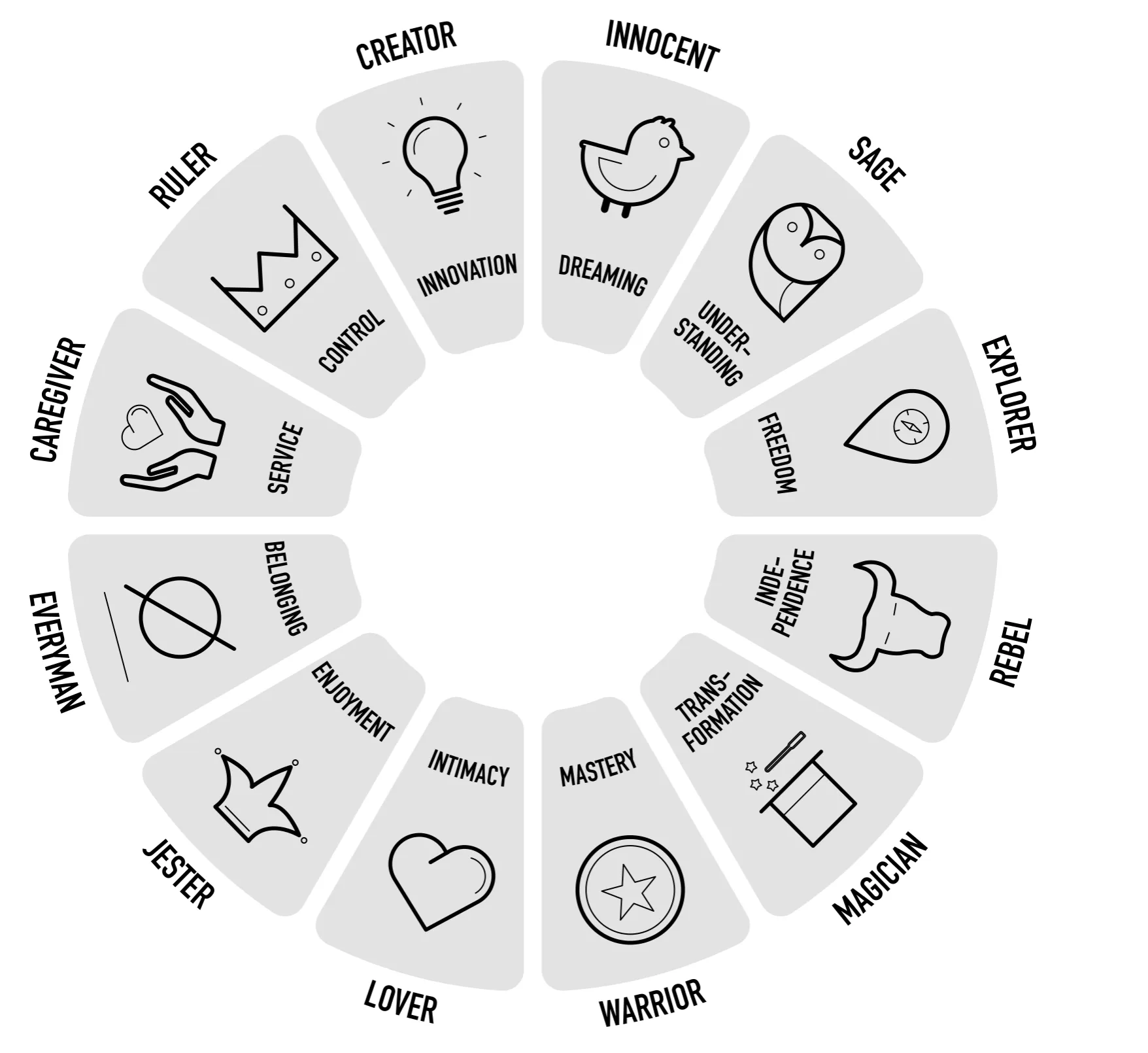
Twelve archetypes. One wheel.
Each archetype is named for the role it plays inside the story we are telling ourselves about a situation. Each one is instantly recognizable — because we've encountered every one of them, in every story we've ever read, watched, or lived.
Pearson organized them in a circle: Innocent, Caregiver, Warrior, Everyman on one quarter; Explorer, Rebel, Lover, Creator across the journey arc; Magician, Sage, Jester, Ruler standing as the figures who have come back from the road with something to offer.
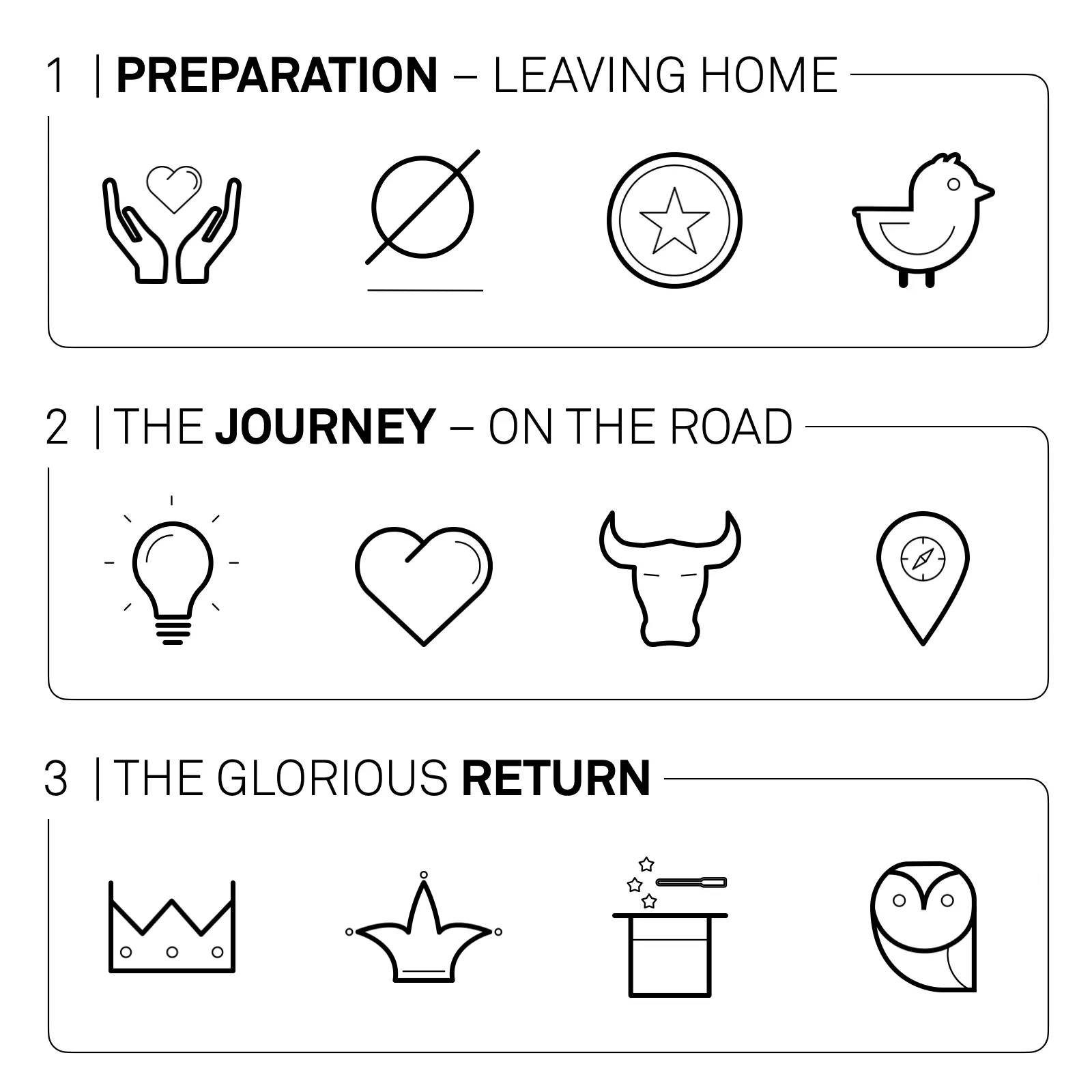
The wheel is the holistic view. The arc is the sequential one. Pearson's three stages — Preparation, Journey, Return — correspond exactly to Joseph Campbell's hero's journey, distilled into four archetypal roles per stage.
The arc
Three stages. Three different selves.
Preparation — leaving home. The figures here are still becoming themselves: the Innocent dreams; the Caregiver serves; the Warrior pushes; the Everyman refuses hierarchy.
The Journey — on the road. The figures here are tested and changed: the Explorer seeks freedom; the Rebel tears up the map; the Lover commits; the Creator invents.
The Return — coming back with something to offer. There are four shapes a mature, completed figure can take in this stage: Ruler, Magician, Sage, Jester.
Each of the four Return archetypes knows how to do something the other three can't. The Ruler commands. The Magician transforms. The Sage explains. The Jester reframes.
Once you have these four shapes in mind, advisors get very easy to read.
02 · The consultant map
Most consultants are Rulers or Magicians. That's why you walked out feeling smaller.
The Ruler-consultant sells you his supremacy. Superior methodology. Battle-tested frameworks. A maturity model with your name on it. The implicit promise is access — come work with us, and you'll have what we have. This is the operating mode of the tier-one strategy houses: McKinsey, Bain, BCG. The deck is excellent. The methodology is real and highly decorated. The room reorganizes around their authority. Whatever brief you walked in with gets fitted into their architecture, because their architecture is the value proposition.
The Magician-consultant is doing something more seductive — and more dangerous. He democratizes transformation. He doesn't claim authority over the magic; he sells you a wand and tells you it'll work in your hand too. AI is the wonder weapon. Here's how to wield it. What he doesn't mention is that this is exactly the plot of The Sorcerer's Apprentice. Sorcery without judgment doesn't make you powerful — it floods your basement. The Magician gets to walk away after the demo. You're left with a transformation tool whose downstream consequences are entirely yours.
The Sage-consultant exists, and at his best, is the most intellectually serious of the four. He understands the field. He has read everything. He can explain what's happening with precision. The problem is that the Sage is mostly not of this world. Too detached to feel the heat of an actual decision, and usually a poor seller because selling feels beneath the work. You'll find him as a keynote speaker, a board advisor, an HBR contributor. Rarely in the room when something has to be decided by Friday.
The Jester-consultant is almost extinct. The Jester doesn't sell supremacy, doesn't sell magic, doesn't sell explanation. The Jester reframes the question — and is the only one in the room with permission to tell the king the truth. That permission is structural: he stands outside the hierarchy, so his truth-telling doesn't trigger the hierarchy's defenses. In the modern advisory market, this position is so unfamiliar that most owners don't recognize it when they encounter it. They have been trained by Rulers and seduced by Magicians. The Jester just looks like someone asking inconvenient questions.
The first three archetypes all do something to you. The Jester does something with you.
03 · The personal pivot
Let me put myself on this map.
Stage 1 — Warrior × Everyman. I started inside the structure. Consulting in IT, soon my own boutique. I was a Warrior — always pushing, always trying to win the brief, working the hours the success commands. But under the Warrior was an Everyman: my Warrior energy was deployed without ever taking the corporate hierarchy seriously enough to internalize its dogmas. The lightheartedness wasn't faith — it was refusal to be impressed. I never quite became the kind of consultant who only saw the deck. And I cared, sometimes too much, about the businesses I worked on and the people inside them. The empathy got in the way of the cynicism that would have made the Ruler path easy.
Stage 2 — Rebel × Explorer. Then came the journey. Twenty years of being inside rooms — Allianz, Volkswagen, Philips, Vodafone — where transformations were actually being decided. What I noticed was that the frameworks I had been trained to apply rarely fit the situations I was trained to apply them to. I started disrupting them. Quietly at first, then less so. I went looking for what actually worked, which often meant going somewhere the methodology didn't reach. That is the Rebel doing the Explorer's job: tearing up the map in order to find the territory.
Stage 3 — Jester × Sage. I came back from that journey uninterested in the two paths most of my peers were walking. I didn't want to rule. I was not going to build a consultancy with my name on it, scale a methodology, become a brand on a partner page. I also didn't want to transform. I had seen too many magicians flood too many basements. What I wanted was the position that had served the boardroom best in every transformation I had watched succeed: the one whose license to speak came from not being in charge. The Jester, with the Sage's reading list behind him. (More on the arc on the About page.)
The discomfort isn't a side effect of the work. It is the work. The uncomfortable question is the one that leads to the answer that actually fits — not the answer the brief was asking for.
04 · How to use this on Monday morning
Four archetypes. Four ways of opening a conversation. Listen for which one you're hearing.
The Ruler offers you his methodology. "Our approach is built on…" "Our framework has three pillars…" "Our diagnostic Sprint…" He is selling you access to his order. If your situation is well-defined and you need scale execution, he is the right call.
The Magician offers you his vision. "AI will transform your…" "I'll show you what's possible…" "Imagine what we could…" He is selling you the wand. If you genuinely need a vision shift and you're prepared to govern the transformation yourself, he can be useful — but read The Sorcerer's Apprentice first.
The Sage offers you his analysis. "Here's what the field looks like…" "The literature suggests…" "There are three schools of thought…" He is selling you understanding. If you need landscape clarity before you decide, he is excellent.
The Jester does something different. He doesn't offer. He asks. In the first hour, watch for who is talking and who is listening. Watch for whether the conversation is about his methodology or your situation. Watch especially for whether the question you walked in with is the question still being discussed an hour later — or whether it has been allowed to change.
If you walked out of your last consultant meeting feeling smaller — and into this article hoping you'd find something that resonates — the advisor you need isn't a Ruler or a Magician. You need someone with permission to ask what's actually broken.
The Jester is the only one with permission to tell the king the truth. That ain't a joke. It's the job.
Primary works and canonical references that underwrite the article — from Jung's collective unconscious to Erasmus's licensed Fool. Pick one and read past the article you're standing in.
✱
Awakening the Heroes Within
Carol S. Pearson
Book · Canonical
Awakening the Heroes Within
Carol S. Pearson · 1991
The 12-archetype book itself. The framework this article uses, written by the source. If you want to go deep on the wheel, this is where to go.
The book that took Pearson's psychology framework and made it a working tool for brand and business strategy. The canonical text on archetypes-in-business.
Jung's most accessible primary work — the collective unconscious explained by Jung himself, written for general readers. Higher payoff than any secondary explainer.
The Rotman dean's argument that productized strategic frameworks are mostly a defense against having to make actual judgment calls. Underwrites the Ruler diagnosis.
The Renaissance scholar who wrote a 90-page satire as the Fool, because the Fool was the only one allowed to say what he wanted to say. Five centuries of evidence for the Jester's structural permission.
Specific to this article. General questions about working with Robert live on the About page.
01Can a consultant be more than one archetype?+
Yes — most carry two. The dominant one drives how they open a conversation; the secondary gives them depth. I describe myself as Jester × Sage. The Jester reframes; the Sage's reading list is what makes the reframe credible rather than glib.
02What's the difference between a Jester-consultant and someone who's just contrarian?+
Sage backbone. The Jester without the Sage's depth is a deflationist who can puncture but can't build. The Jester with thirty years of operator experience can reframe toward a workable answer, not just against the wrong one.
03Are McKinsey, Bain, BCG bad?+
No. Rulers serve well-defined problems at scale brilliantly. The issue isn't quality — it's fit. If your problem is clearly defined and you need an industrial transformation rolled out across a Fortune 500, a Ruler is correct. If your problem hasn't found its right name yet, a Ruler will fit it into theirs and you'll spend money solving the wrong thing efficiently.
04Is the Jester position only useful for AI advisory?+
No — but the AI moment is unusually rich in Ruler and Magician posture right now, because AI sits at the intersection of frameworks-that-promise-order and visions-that-promise-transformation. That's why the Jester archetype matters more in 2026 than it did ten years ago.
05How do I find a Jester-archetype advisor when most of the market is Rulers and Magicians?+
Watch the first hour of any first conversation. Count how many minutes the advisor spent talking versus listening. Notice whether the question you arrived with is the question still being discussed. Notice whether they offered methodology unprompted, or whether they asked something you hadn't expected. Jesters reveal themselves through what they don't do.
06Doesn't every advisor claim to "ask the right questions" now?+
Yes. The claim is cheap; the position is rare. The test isn't whether the advisor uses the language — it's whether their commercial structure allows them to actually do it. A 10-day Sprint cannot allow the brief to change because the brief is the deliverable. Watch for what the engagement is structurally able to do, not what the website promises.
07How long does a Jester-style engagement take compared to a productized one?+
Variable, by design. The work shapes itself to what the situation needs. Some engagements are a single 60-minute conversation that surfaces the actual question and ends there. Others are nine-month operating-model redesigns. The shape isn't pre-decided.
08Why does this article say so little about AI specifically?+
Because the article isn't about AI. It's about how to choose the kind of advisor your situation actually needs — and that choice predates AI and will outlast the current cycle. The AI Trap article (POV #1) addresses AI directly. This one is the methodology piece behind it.
09Where did Rob get these icons and visuals from?+
Rob built the graphics himself, in collaboration with Barbara Frischen — Babs to those who know her. Barbara is one of Rob's all-time favourite colleagues and longest-standing partners-in-crime. They spent seven years together at Geometry, where Babs became his co-conspirator inside the Archetype framework — the one who could turn a half-formed strategic instinct into a visual language clients actually understood.
The wheel, the journey breakdown, and the icon set you see throughout this article carry her fingerprints. Credit where credit is enormously due.
Let's meet
Want to see which type of conversation this is?
Sixty minutes. No agenda required. By the end, you'll know whether the question you walked in with is the question worth answering — or whether it's the right time to let it change.