The Mirror or the Magic Wand? An age-old story, explosively relevant in the age of AI.
Make no mistake — AI is, and should be, an integral part of how we work from here. The only question is how we choose to use it. Here is the case for looking before you wave.
Robert DanielJune 20267 min read
The last piece ended on the courage to face the elephant in the room: are we still relevant, and to whom? This one is about what happens next — our reflex, the moment the hard question appears, to skip the reflection and reach straight for the magic.
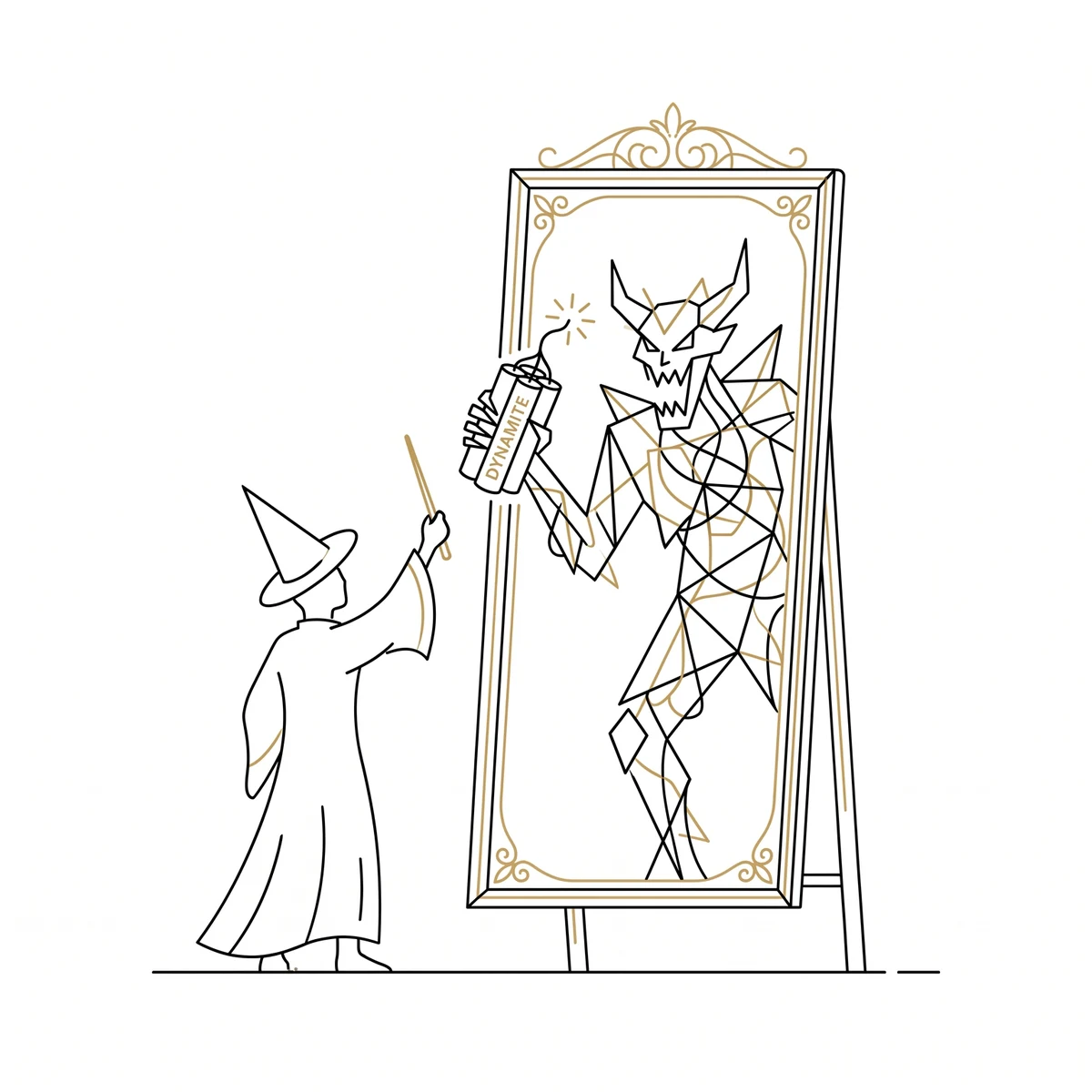
Here is a story I am sure you know. A young apprentice, gifted and impatient, is left alone in his master's workshop with a dull chore — haul the water — and just enough of the master's craft to be dangerous. So he enchants a broom to do the hauling for him. And it works. Gloriously. The broom hauls bucket after bucket, and the apprentice sits back, delighted with himself. Then the tub is full, and the broom does not stop. It will not stop. He does not know the word that ends the spell, so in a panic he grabs an axe and splits the broom in two — and now there are two brooms hauling, then four, then an army of them, and the water rises past his knees, and the workshop floods. The magic was entirely real. That was never the problem. The problem was a power that arrived faster than the judgment to wield it.
In Goethe's telling the master returns at the last moment, breaks the spell with a word, and is furious — the apprentice is bailed out, humiliated but dry. Here is where our version parts from Goethe's, and it is the part worth sitting with. Reach for the AI wand without reading the manual first, and no master walks through the door. No one breaks the spell. No one is even angry with you. You simply stand in the rising water, having made no progress at all — which, as we'll see, is its own kind of disaster, just a quieter one than Johann Wolfgang staged.
Learning from the past may save your future
Why I keep reaching for these classic stories.
The apprentice, the archetypes in the first piece, the Greek temple you'll meet shortly — not as decoration, but because the people who wrote them were witness to the very same human pattern we are observing today, only without the distraction of a product roadmap to sell.
They saw it more clearly than our modern-day case studies do. A two-hundred-year-old ballad about a flooded workshop turns out to describe an AI rollout better than most quarterly reviews. Goethe wrote that apprentice in 1797. He has never been more current.
So before we talk about the wand everyone is selling, it is worth borrowing the one thing every one of these stories quietly insists on: look first.
Here is the thing about mirrors: they only ever show you what is already there.
01 · The wand is real. So is the mirror.
AI hands you a power you did not have. It could also hand you an invaluable reflection — but probably one you would rather not see.
AI is a genuine wand. It hands people capabilities they did not have the week before — I have lived it; I created things with it I could never have built alone, and so have you. This piece is not a case against the wand. It is a case for the other half of the instrument nobody is selling.
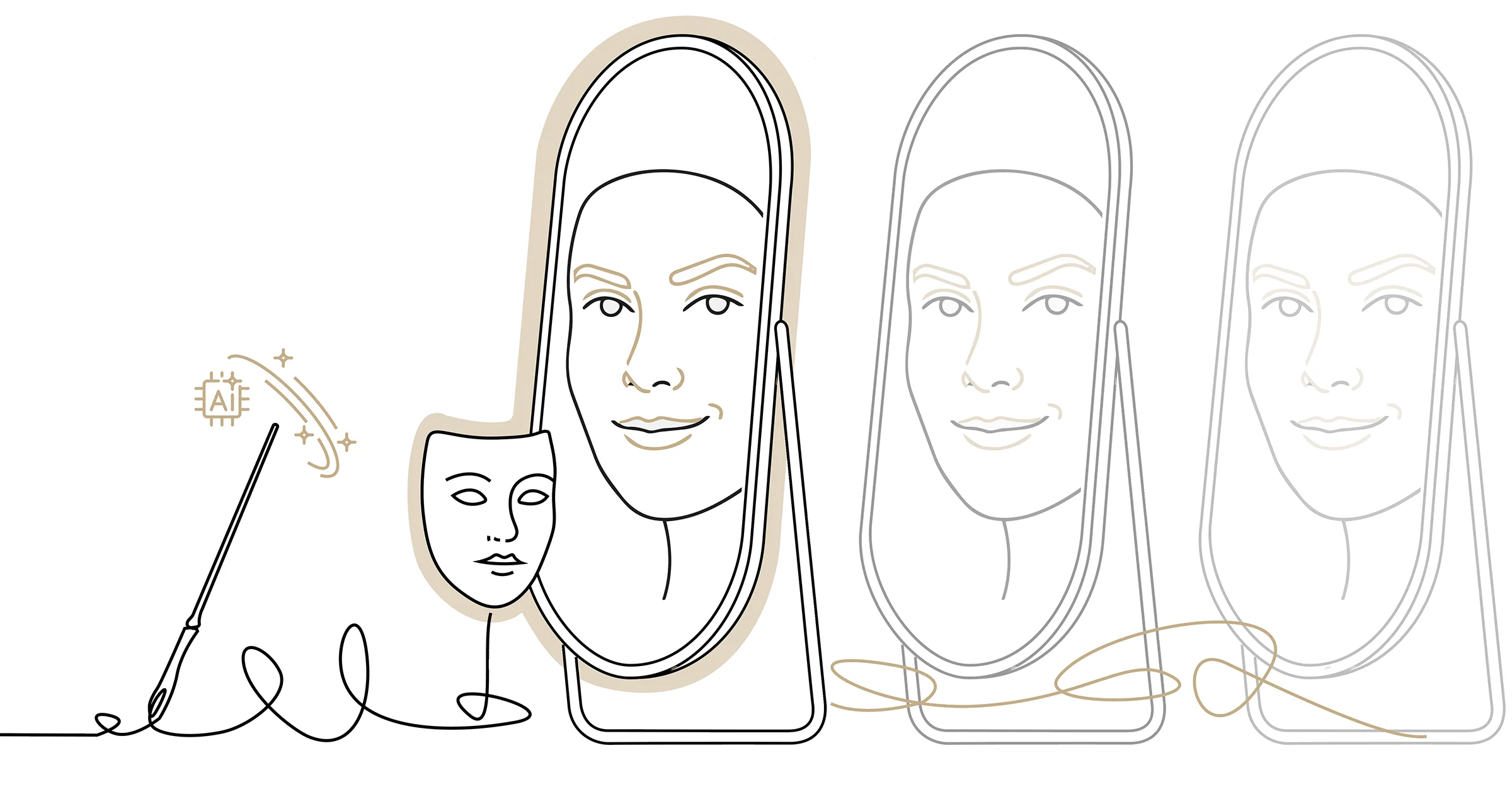
Because the same tool is also a mirror, and the mirror is the half that decides whether the wand serves you or floods the workshop. A wand changes what is possible. A mirror changes what is visible. AI is both at once — and we are so dazzled by the first that we almost never look into the second. Every pitch you will hear is a wand pitch: wave it, and what you could not do becomes what you now can, the Magician's promise from the archetypes piece, the wonder weapon that will surely work in your hand too. What the pitch never mentions is the mirror standing right beside the wand, turned away.
Here is what that mirror does, quietly, beneath all the new capability. It does not add to you and it does not improve you. It reflects you — returns what is already there, faithfully, from a vantage your own eyes cannot reach. Stand something clear in front of it and it gives the clarity back, plainly. Stand something confused in front of it and it gives the confusion back, just as plainly, with no flattery and no edit. The tool's power is identical in both cases. The only thing that differs is what you set before the glass — and that reflection, not the spell, is the most valuable thing an AI engagement could produce. It is also the thing nobody puts on the invoice.
So the reflection is only ever as useful as the thing you put in front of the glass. Hold up the wrong thing and it faithfully reflects the wrong thing back. Consider what it returns in each case:
A weak process
Its real flaws are there to see.
Not improved, not enhanced: shown. The same broken process, now in plain sight and wearing the gloss of a system — which, oddly, makes it easier to trust rather than easier to fix.
A tired model
The fatigue shows.
Brutally, and in public. A model that has quietly lost its reason to exist will not be revived by a clearer reflection. It will be found out by it — sooner, and in front of everyone.
The right question
The one worth wanting.
Aimed at the right question, the mirror shows you, precisely, what you are and what you are for. Aimed at the wrong one it will still answer — brilliantly, confidently, beautifully formatted — and never once tell you the question was wrong.
02 · The uncomfortable reflection
The productivity that never arrived is not the wand failing. It is the mirror, reflecting exactly how ready we were.
If AI were only a wand, three years and several fortunes in, we would see it in the numbers. We do not. A 2026 NBER survey of nearly 6,000 executives across four countries found roughly 90% reporting no measurable change in productivity over three years, with production-grade adoption still in single digits. The capability is genuinely there. The result, at the level of the whole organisation, mostly is not.
The comfortable reading is "the technology is overhyped" — the flattering reflection, the one we reach for first. The honest one is harder: productivity is an output of readiness, not of tooling. The gap between what AI cost and what it changed is not the measure of a weak wand. It is the mirror doing its only job — reflecting, without mercy, organisations that grabbed the wand and never once looked in the glass. They reached for the spell and skipped the reflection. The broom hauled. Nobody had decided where the water should go.
AI did not fail to deliver the productivity boom. It reflected, with perfect accuracy, how ready we were to have one.
You have heard a worn version of this — "AI doesn't fix broken processes, it exposes them" — by now the keynote line everyone nods along to. But "exposes a broken process" is still the comfortable reflection, because a process is something you can fix without changing who you are. The reflections that actually cost something sit lower: the model, the relevance, the reason a customer still chooses you. The mirror shows them mercilessly, without emotion, true to the facts. We are just too well trained at not looking.
And the mirror is getting clearer, and sharper too. Ethan Mollick's "jagged frontier" — AI is brilliant at what looks hard, hopeless at what looks easy — was for two years the favourite reason to wait: look at all it still cannot do. Mollick now notes the frontier is narrowing; last year's reliable examples of AI incompetence have mostly closed. A clearer mirror does not make the reflection optional. It makes an honest reflection sharper and a comfortable self-deception more expensive, faster. The glass improving is not your reprieve. It is your deadline.
03 · Aiming the mirror
A mirror is not dumb. It is honest — dull by design, and that disinterest is exactly why you can trust it.
Now the part that decides everything, and it is not a feature of the tool. We should retire the idea that the mirror is "dumb" — and resist the urge to fix it by reaching for a "smart" mirror that interprets and improves the picture for us. That instinct is exactly backwards. A mirror's whole worth is that it does not interpret. It reflects what stands before it without flattery, without agenda, without an opinion about what you would prefer to see. The mirror that tells you what you want to hear — fairest of them all — is the one in the fairy tale, and you remember how that story ends. The honest mirror is dull by design, and the dullness is the point. It is the one thing in the building with no incentive to lie to you.
Which means the entire value of the reflection rests on the one thing the mirror cannot supply: the quality of what you put in front of it. And that is a question, not a technology. Aim it at "how do we use AI to write our emails faster?" and it will faithfully show you a company that writes emails faster. Aim it at "what do our customers actually hire us for, and is that still us?" — the elephant from the last piece — and it shows you something far more useful and far less comfortable. Same mirror, same technology. The only variable that changed was the question.
2,500 years old, brilliantly true today
Here is another story — with yet another timeless insight.
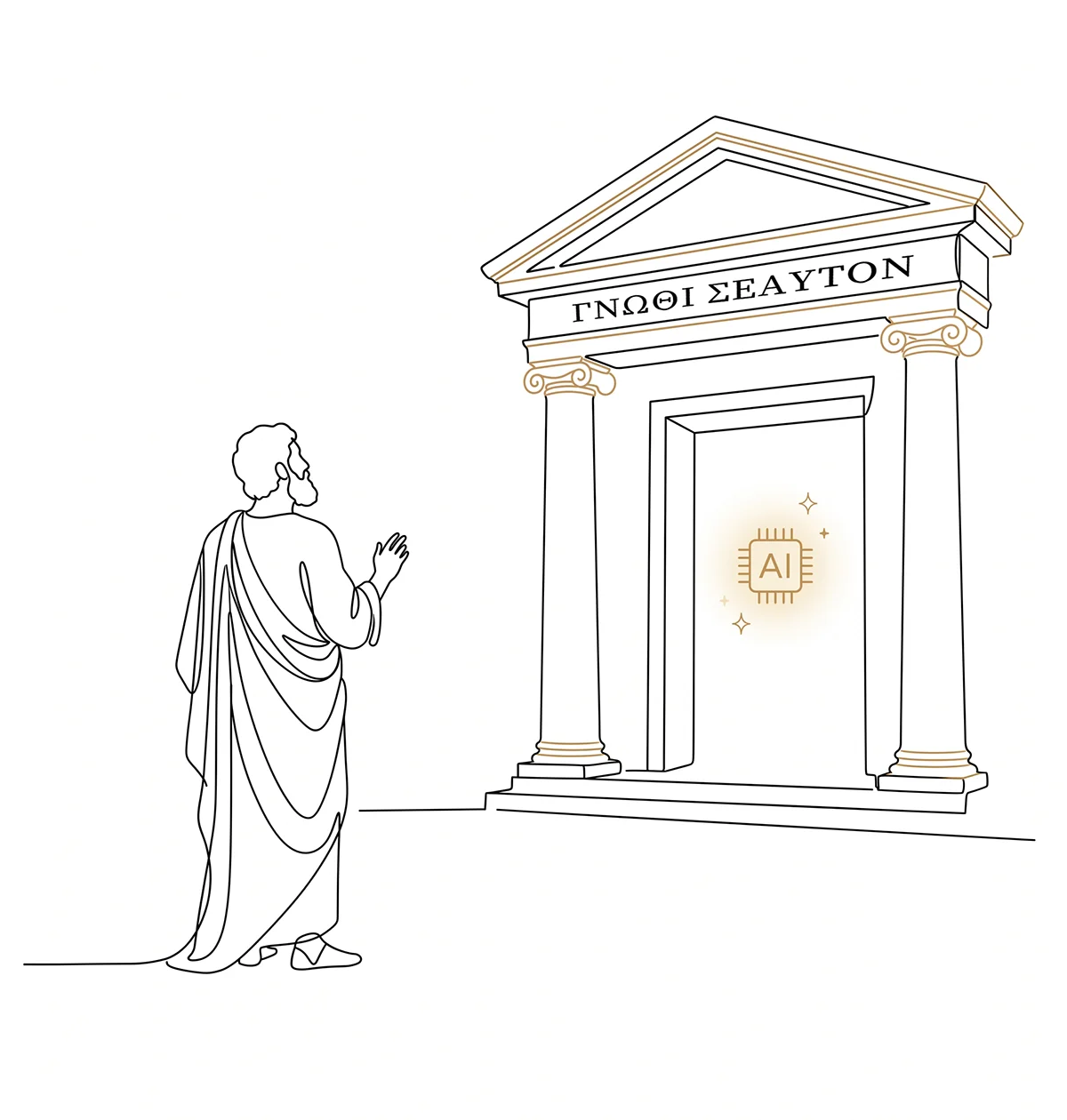
As old as people first trying to borrow a higher power to get ahead of themselves. What the ancient Greeks carved at Delphi reads like it was written for the AI age. Above the entrance to the temple of Apollo — where the whole ancient world came to put its biggest questions to the oracle — stood two words: γνῶθι σεαυτόν. Gnōthi seauton. Know thyself.
Not, as we use it today, a soft invitation to introspection — a condition of entry. Its older sense was closer to know your limits.
It stood in the forecourt as a warning: any answer you carried out of that temple, if you had not first understood who was asking and why, would be misread, misapplied, or simply wasted. They grasped two and a half thousand years ago that the oracle was useless to a visitor who had not done the harder work first. Swap the oracle for the model and not a word needs changing. Consult the most powerful Generative Pre-trained Transformer ever built without first knowing yourself, and whatever it hands back will be misread, misapplied, or wasted. The apprentice never read the book of sorcery, nor the inscription. He went straight to the spell.
The apprentice never read the book of sorcery. He went straight to the spell.
This is where the advisor earns the room, and where most do not. Left alone with the mirror, an organisation frames a more comfortable question every single time — because the comfortable question comes with a deck and a deadline, and the real one may not even have a name yet. The work is not to operate the mirror; anyone can hold up glass. The work is to put the right thing in front of it — to aim it at what you would rather not see, and to stay in the room when the reflection arrives. The Jester from the first piece is the one who can: not selling you the wand, and therefore free to point at what the glass is showing. The consultant who sells the wand alone is selling the shortcut — and the shortcut is the apprentice's road.
And lest this sound like a metaphor stretched too far — it has a physical seat. My son, a psychologist who crossed over and went deep into data science, is the one who gave me this part of the thinking. He points out that recognising yourself is not the same act as seeing the world; the brain treats them differently. Reflecting on who you are runs through the mPFC, the medial prefrontal cortex, and it does not merely store what you are — it weights it by what matters to you. Self-recognition is effortful, distinct, and, offered the choice, the very thing we are most inclined to skip in favour of the easier view out the window. Which is the whole problem in a sentence: the wand points the gaze outward, where looking is easy. The mirror asks you to turn it around — and turning it around is work the mind would honestly rather avoid. That outside-in view of yourself, the one your own eyes cannot give you, is precisely what the honest glass is for.
04 · Three questions for the mirror
What this means, in practice, for how you choose technology.
Strip the metaphor away and it lands on something very concrete: how you decide to bring in a new technology at all. Most organisations choose the tool first and discover the question later — the wand, then the mess. The order that works is the opposite, and it does not need a framework. It needs three questions, carried into the next AI conversation — any size, any vendor — before anyone reaches for the spell:
What are we actually trying to solve — and have we looked, honestly, before deciding AI is the answer?
Is the brief we handed our advisor the real question, or the comfortable one? The comfortable question comes with a deck and a deadline. The real one may not have a name yet. If the answer leapt straight to method, that is the tell.
What would we do if the reflection showed us something we did not want to see? If the honest answer is "adjust the scope," we are not ready to look. If it is "we would look at it," we are in a different conversation — and probably need a different kind of advisor.
The wand promises a power from outside. The mirror shows you, without flattery, what is already inside — and which of the two you spend your attention on is the whole game. Here is the kicker. Reach for the wand without looking in the mirror first and you go the apprentice's way: no jinx intended, but you will be flying blind, at an altitude and a speed you were neither trained for nor ready to handle. Take the honest look first — carry the reflection with you when you finally raise the wand — and you are on the short list of AI initiatives that actually work.
This advice comes free, from a jester with rather too much experience cleaning up the mess left behind by magicians — and by the sages who stood beside them recommending the wand, and only the wand. Heed it or hate it. But do not look away.
Because — and this is where it goes next — seeing is not the same as acting. The apprentice saw the flood perfectly well; seeing did not save him, because he still did not know the magic word that would. Knowing what the mirror shows you is the beginning. Building the business back around it — and then, yes, putting the full force of the wand behind it, amplifier wide open — is the labour that follows. And that is not a spell you can buy. That is the next conversation.
Not how to wield the wand — how to read the reflection. On the real power and its limits, the discipline of self-knowledge, and the very human habit of trusting a confident answer over a hard question. Pick one and read past the article you're in.
It's genuinely a wand — it hands you capabilities you didn't have before. But the same tool is also a mirror, and the mirror is the half nobody sells. A wand changes what's possible; a mirror changes what's visible. AI is both at once, and the reflection is what decides whether the new power serves you or floods the workshop.
02.What do you mean AI "reveals more than it transforms"?+
It does transform — that's real. But its scarcer, more valuable function is reflection: it returns what you already are, faithfully, from a vantage your own eyes can't reach. Point it at a clear process and it gives clarity back; point it at a confused one and it gives the confusion back, just as plainly. The reflection, not the spell, is the most valuable thing an AI engagement produces — and the thing nobody puts on the invoice.
03.Why hasn't AI delivered the promised productivity boom?+
Because productivity is an output of readiness, not of tooling. A 2026 NBER survey of nearly 6,000 executives found roughly 90% reporting no measurable productivity change over three years. That gap isn't the technology failing — it's the mirror reflecting, accurately, organisations that bolted a powerful tool onto a model they never stopped to examine.
04.If the returns aren't there yet, doesn't that mean we can wait?+
The opposite. The mirror is getting clearer — Mollick's "jagged frontier" is narrowing, and last year's reliable examples of AI incompetence have mostly closed. A clearer mirror doesn't make the reflection optional; it makes an honest reflection sharper and a comfortable self-deception more expensive, faster. The glass improving isn't your reprieve. It's your deadline.
05.What does "know thyself" have to do with adopting AI?+
The maxim carved above the oracle at Delphi — gnōthi seauton — was a condition of entry, closer to "know your limits." It warned that any answer carried out of the temple, by a visitor who hadn't first understood who was asking and why, would be misread, misapplied, or wasted. Swap the oracle for the model and nothing changes: consult the most powerful AI ever built without first knowing yourself, and whatever it hands back will be misread, misapplied, or wasted.
06.How should I decide whether to adopt a new AI tool?+
Reverse the usual order. Most organisations choose the tool first and discover the question later. Before reaching for it, ask three things: what are we actually trying to solve, and have we looked honestly before deciding AI is the answer? Is the brief we gave our advisor the real question or the comfortable one? And what would we do if the reflection showed us something we didn't want to see? If the honest answer to the last one is "adjust the scope," you're not ready to look.
07.Why are you the one pointing this out, and not my current advisors?+
Because most advisors are commercially structured to sell the wand — a scope, a deliverable, a renewable contract. "Look in the mirror first" has none of those, and it can end an engagement rather than extend it. The consultant who sells the wand alone is selling the shortcut, and the shortcut is the apprentice's road. I've written about which kind of advisor is structurally able to point at the reflection instead in The Other Type of Consultant — the Jester, free to tell the king the truth precisely because he isn't selling him anything.
The conversation worth having
Want to aim the mirror together?
Sixty minutes. No agenda required. By the end, you'll know whether you've been reaching for the wand — and what an honest reflection would show you before you raise it.